AI Bookkeeping for Accounting Firms: How We Scaled to 250+ QBO Clients Without Adding Headcount
AI Bookkeeping for Accounting Firms: How We Scaled to 250+ QBO Clients Without Adding Headcount
AI Bookkeeping for Accounting Firms: How We Scaled to 250+ QBO Clients Without Adding Headcount
AI Bookkeeping for Accounting Firms: How We Scaled to 250+ QBO Clients Without Adding Headcount
Most accounting firms manage dozens of QBO logins and hope for consistency. Here is how AG Accounting automated bookkeeping across 250+ startup clients
Accounting Operations
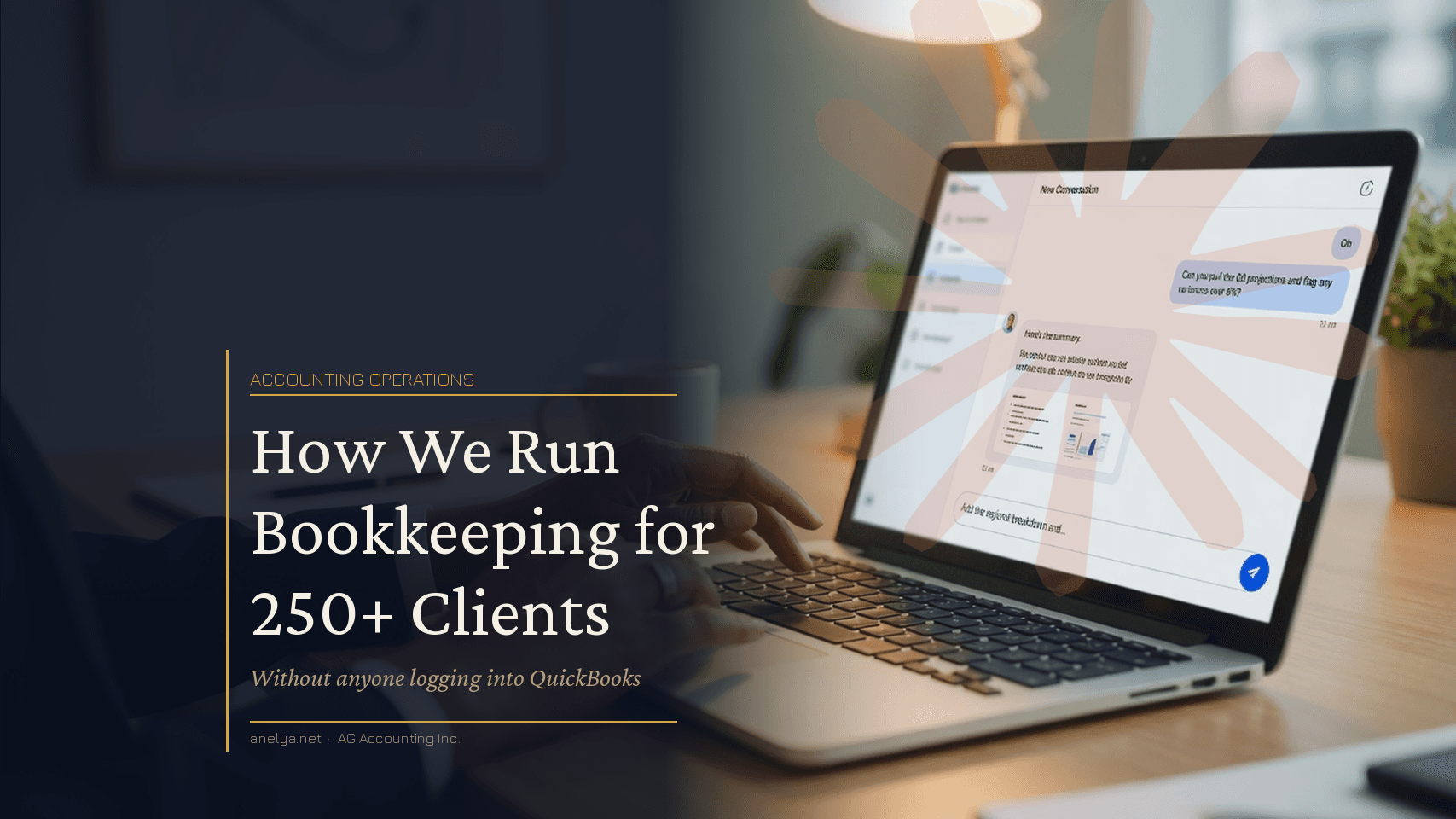
Most accounting firms solve a capacity problem the same way: hire another bookkeeper. After running our practice for years on that model, we found a different answer. AG Accounting now manages 250+ startup clients using AI bookkeeping through Numbers Game – and our team has not logged into a single QBO instance directly since we made the switch. Here is what that change cost us to build, what it took to get there, and what our bookkeepers and fractional CFOs actually get from it.
Why Accounting Firms Hit a Capacity Ceiling
The ceiling in most accounting firms is not talent – it is context-switching. A bookkeeper managing 30 clients spends a meaningful portion of every day just reorienting. Log into Client A’s QBO, categorize transactions, export what you need, close the tab, open Client B. By mid-morning you have touched four clients. The rest of the day is the same cycle.
Every firm develops workarounds: spreadsheets, Slack threads, sticky notes about which vendor always comes in miscoded for which client. The institutional knowledge accumulates in people’s heads. It works until someone leaves, until you onboard three clients in the same month, until your best bookkeeper takes two weeks off. Then you feel exactly how fragile the system was.
We grew by hiring to match the load. That was the only lever we had.
How AI Bookkeeping Eliminated Our QBO Context-Switching
Numbers Game is an AI bookkeeper built specifically for accounting firms managing multiple QuickBooks Online clients. We did not just adopt it – we helped shape and test it. We brought our own practice as the proving ground: our client workflows, our edge cases, our month-end close process, our fractional CFO use cases. The engineering team built it; we stress-tested every corner of it against real books and real deadlines.
What came out the other side was not a generic QuickBooks Online automation tool. It was something designed around the specific friction points that slow accounting firms down at scale – because those friction points came from us.
Numbers Game connects Claude directly to each client’s QBO. Every client lives in its own Claude Desktop project. Context does not bleed between engagements. When a team member opens a client project, they are immediately inside that client’s history, rules, and preferences. No tab-switching. No re-reading last month’s notes. The context is the project.
The Month-End Close Before and After
Before AI bookkeeping, our median month-end close for a busy startup client took two to four hours. Checklist in one tab, QBO in another, adjusting entries in a third, prior reports in a Google Drive folder somewhere. Every close was assembling the same puzzle from scratch.
With Numbers Game, our median close time for a 200-transaction month is 18 minutes. The categorization queue comes back with a proposed rule and confidence score for every transaction. Our bookkeeper reviews, adjusts where their judgment calls for it, and approves. Entries post to QBO. A PDF audit trail attaches to the relevant transactions automatically. The close checklist, adjusting entry proposals, and a branded Close Report PDF all come out of the same conversation.
That 18-minute number is not a best case. It is our median.
What Bookkeepers Gain From AI-Powered QBO Access
The mechanical work of data retrieval is no longer part of our bookkeepers’ day. They are not navigating QBO screens, pulling transaction lists, or re-entering rules they set six months ago. They are reviewing AI bookkeeping proposals, applying judgment, and approving. The work that required expertise still requires expertise. The work that did not is gone.
Onboarding new team members is faster because the institutional knowledge is in the project, not in a colleague’s head. A new bookkeeper opens a client project and the full context of how that client’s books have been managed is there. When we take on a new client, setup is a Claude project and an OAuth connection to their QBO. The onboarding is self-contained and repeatable.
The coverage problem – what happens when someone is out – largely disappears. There is no shadow knowledge to transfer.
How Fractional CFOs Use AI to Answer Client Questions in Real Time
For our fractional CFOs, the value of QuickBooks Online automation shows up differently. The data retrieval layer has largely disappeared from their workflow. Instead of logging into each client’s QBO separately to pull a P&L, check AR aging, or run a variance, a CFO opens the relevant project and asks.
A founder calls asking why G&A jumped in a particular month. Our CFO queries the GL, drills into the transactions, and has an answer with line-item backup before the call ends. Board package due Friday? Pull the P&L, Balance Sheet, and cash flow in one conversation, review the numbers, flag anything that needs an adjusting entry before it goes out. Variance analysis that used to require a separate report request now happens on demand.
Our CFOs carry more clients than they did before. The time that used to go toward navigating systems now goes toward advising founders on what the numbers mean.
The Audit Trail Advantage
Every action Numbers Game takes is logged: the timestamp, the rule applied, the confidence score, and the source transaction in QBO. Every entry can be rolled back. Nothing posts silently. When a client’s auditor asks why a February transaction was categorized a certain way, we answer that question in thirty seconds. The answer is in the log, not in a team member’s memory.
For accounting firms working with any companies heading into audits, this documentation is not a nice-to-have. It is what keeps client relationships intact when the books get scrutinized.
Is AI Bookkeeping Right for Your Accounting Firm
We came to Numbers Game as practitioners with a real capacity problem, helped shape the product around that problem, and have run our practice on it ever since. The context-switching tax was real. The tribal knowledge risk was real. The month-end crunch was real. AI bookkeeping solved all three without requiring us to hire our way out of the ceiling.
If your firm manages more than 10 QBO clients and your team is spending meaningful time on retrieval work – logging in, pulling reports, reloading context – the math changes significantly with QuickBooks Online automation. If your fractional CFOs are limited by how fast they can navigate between systems, conversational access to live QBO data changes what is possible in a client conversation.
We are not describing a future state. This is how AG Accounting runs today.
Anelya Grant is the founder of AG Accounting Inc. (anelya.net), an accounting firm serving tech startups and healthcare organizations. She is also co-founder of JustPaid.ai, an AI-powered billing and contract-to-cash platform for growing companies.